Why We Fish by Randy Rowley 8/22/24 ©
ByIt was dark when Clayton Carrier, Russ Gibbs, and I arrived at Lake Decker, on a hot, windless July morning. After launching my boat, we headed to a small cove normally filled with lily pads in the summer, but for an unknown reason they were absent that year. I activated my trolling motor and we started throwing topwater lures.
We hadn’t gone far when Clayton announced he had a fish on his Loon (black-colored) River2Sea Whopper Plopper (a cigar-shaped torpedo bait that makes a distinctive ‘whopping’ sound). I spot-locked my boat’s trolling motor and grabbed my net. Unfortunately, it wasn’t needed as the fish somehow got off at least one of the lure’s six hooks.
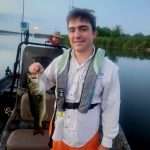
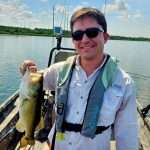
As we went deeper into the cove, we suddenly heard another splash and Clayton had another fish on his Whopper Plopper. I again spot-locked the trolling motor and grabbed the net. This time, the fish stayed hooked and Clayton was soon holding an impressive 19 ¾-inch long bass.
As we neared the left corner of the cove, I saw that the surface was scuzzy, so I switched to a frog and encouraged my friends to do the same.
After going another 100 yards, I threw my Lunkerhunt Prop Frog in Green Tea color almost up to the cattails. I gave it a little jerk and it was immediately slammed by a fish. I counted slowly to ‘two Mississippi’ and set the hook. At first, I thought that it was a dink, as it wasn’t putting up much of a fight, but as I got it close to my boat, I saw that I was wrong. I asked Clayton to grab the net and I soon was holding my own 19 ¾-inch long bass. Probably the scuzzy water kept it from putting up much of a fight.
After another 100 yards, another fish hit my frog. This time, the water wasn’t as scuzzy, and I knew that it was a decent fish. Clayton grabbed the net and I soon was holding an 18 ¾-inch long bass.
We then rounded the point and went around 300 more yards into a bigger cove, but had no more strikes. We then went back to the first cove.
After we rounded the point, I saw a few shad around 75 yards away that were fleeing from something. Surmising that it was schooling bass, I put my trolling motor on its highest speed and chased after them. I dropped my frog rod and grabbed a rod with a clear Yo-Zuri 3DB Pencil Popper dog walker tied on. I got within range and let my Yo-Zuri fly. I started working it and soon had a fish on. I brought it in and was momentarily holding an 18-inch long largemouth.
Then the action stopped. We tried the big cove again but had no success. Then on the way out, we saw splashes, but soon saw that they were caused by gar. We made it to the main lake arm where we saw more splashes, and saw that they were bass. The splashes were infrequent, and the bass didn’t stay up top for long, but there was enough action to keep us chasing the schoolies for a couple of hours.
A couple of bass made splashes behind the boat and to my left. I chunked my dog walker into the midst of them and soon landed my last bass of the day – a 15 ¼ incher. Clayton, who had switched to a bone-colored Whopper Plopper, then landed his second and final bass – a 19-incher. I also had two fish somehow miss my Yo-Zuri, and it’s 5″ long and has nine hooks! Russ practiced casting – why he didn’t hook any fish is a mystery.
Largemouth bass fishing with lures is an iffy endeavor. Even those who are very good at it are unsuccessful more often than not.
Those who have fished with me know that I usually throw fast-moving baits. Top waters (dog walkers, propeller baits, poppers, and frogs), crankbaits (lipless, square bills, and round bills), spinnerbaits, chatterbaits, swimbaits, and jerkbaits are my staples, and I only use slow-moving baits like worms, crawdads, creature baits, and jigs as a last resort. Yes, I’ve caught many bass with slow baits, but their leisurely presentations make me want to take a nap, and if I’m going to take a nap, I prefer that it be horizontal and not while sitting with a fishing pole in my hands.
The act of casting and retrieving one of my preferred baits takes around two minutes, on average. A lot of casts are faster, but some are slower because I must pick grass off my lure or I have a backlash. That’s 30 casts an hour. Subtracting an hour to drive my boat around and to get people’s lures unstuck, that’s 180 casts for every seven-hour-long fishing trip, on average. And I average catching around three bass every trip. Some days are better, but other days are worse. But I’m successful one cast out of every 60, on average – that’s not a very good success ratio!
Over the years, I’ve fished with a lot of fishermen, including several guides – some have better success ratios than me; others have worse. If we were that unsuccessful while dove hunting or clay target shooting, most of us would have sold our shotguns long ago! (Of course, that’s not an apples-to-apples comparison, as we can, hopefully, see our feathered and clay quarries and usually can’t see our finned quarries.) Yet, despite our limited success, we’ll keep fishing as often as we can.
So, why do we keep going fishing, knowing that we’ll have tight lines infrequently at best? It’s because fishing is about more than the thrill of a fish hitting your lure and the tug on the line. Other reasons to fish include:
- being in God’s creation (including experiencing gorgeous sunrises and sunsets, the stillness of the water, awesome thunderstorms, thick morning fogs, and watching the earth wake up and go to sleep);
- fellowshipping with others with like goals and desires;
- relaxation including leaving adulting and the stress of the world behind;
- the challenges of outsmarting a worthy opponent, and pitting ourselves against nature and the elements; and
- providing food for our families, including directly taking responsibility for obtaining food.
But perhaps the most important reason that we fish is that most casts are full of hope and the potential to make things different – to change a bad day into a good one. Before we cast, we must decide which lure to throw, and what size and color. Each cast entails a multitude of decisions, such as do I throw my lure next to the grass or over by the rocks or stumps, do I fish my lure fast, medium, or slow, and do I use the stop-and-go method or a steady retrieve. Each cast has the possibility that something that I do might make a difference.
Sometimes, we’re having a slow day, when suddenly something changes and we start having tight lines. And we’re never quite certain what made the change – was it because I changed lures or colors (including changing from a dull to a shiny lure or vice versa), I cast to the standing timber instead of the grass, I reeled my lure in slower or faster, the barometric pressure dropped suddenly, the sun came out, the wind picked up, or something else?
Most of my friends don’t believe in luck, and instead regard success as God’s blessings. For example, putting your lure at the right spot, with the right presentation, and at the right time elicits a strike. But throwing to that spot with the same lure and same presentation five minutes before didn’t result in a tight line, simply because the fish wasn’t there.
Unfortunately, I’ve gone on more than a few fishing trips where I didn’t get a bite. Many times, I wanted to quit, but I kept fishing hoping that the next cast would be the one to make things different.
Do we approach sharing the Good News of redemption through faith in Jesus in the same manner? Do we think that the next time that we share our faith with someone it might be the time that they bite? Just as catching a fish on a slow day can entirely change our perspective (as catching one fish is infinitely more than none), seeing someone repent of their sins and reel Jesus into their life can entirely change our perspective and hook us into a habit of sharing the Good News.
When Jesus encountered Peter and Andrew fishing at the Sea of Galilee, he told them, “‘Follow Me, and I will make you fishers of men.’” Matthew 4:19b (NASB). And the last words that he said to his disciples before he ascended into heaven were, “‘Therefore go and make disciples of all nations, baptizing them in the name of the Father and of the Son and of the Holy Spirit.’” Matthew 28:19. Notice that he didn’t say, “I will make you fishers of men unless they don’t bite” or “Go and make disciples unless they don’t bite.”
Many people struggle while fishing because it requires faith in things they cannot see. The same is true with our mission to make disciples. Just as most of us will never stop angling for fish, we must never stop fishing for people and always believe that the next time that we share our faith will make a difference.
Randy
Clayton